Compliant Missed Call Text Back Recovers 20–40% for UK Trades
SmartFlow Team
AI-powered business operating system
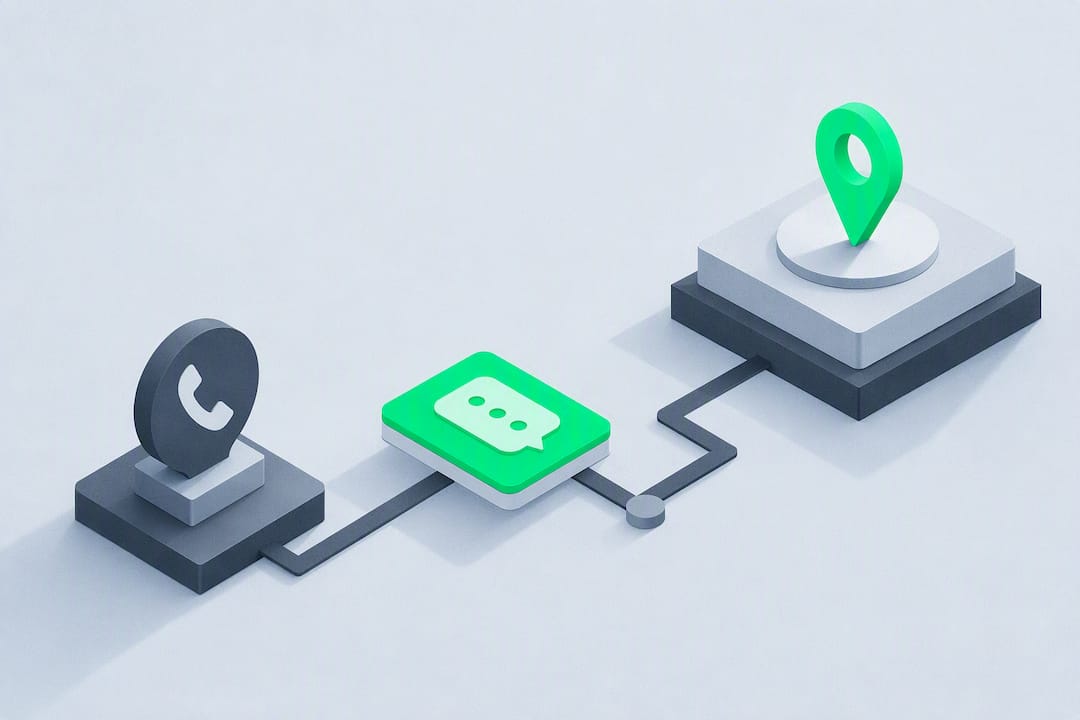
Missed call text back sends an automatic SMS the moment a call goes unanswered, turning a lost enquiry into an open conversation before the caller has even put the phone down. Answered well, it recovers a real share of missed callers because it lands while they’re still thinking about you, not hours later. The next step is simple: switch it on in your phone system or CRM, send yourself a test call, and check the reply arrives within a minute.
TL;DR:
- Sending an automated SMS within 30 to 60 seconds of a missed call can recover between 20 and 40 percent of missed inquiries.
- Proper setup requires choosing correct triggers, using authenticated sender IDs, and testing delivery times with real calls to avoid delays or blocks.
- Messages should be concise, personal, and focus on a single clear action, including an opt-out option to ensure compliance.
- This approach works best for quick-decision businesses like trades, appointments, or urgent services, but less so for high-value, qualification-heavy sales.
- Accurate logging, disciplined opt-out handling, and thorough testing are essential to prevent failure or regulatory breaches that could lead to significant fines.
Table of Contents
- What is missed call text back and why does it matter?
- When does missed call text back actually help?
- How do you set up missed call text back step by step?
- What should your missed call text actually say?
- What are the UK compliance rules for text-back messages?
- How do you measure whether it’s actually working?
- How SmartFlowCRM handles this end to end
- The checklist that actually matters
- Get missed call text back running this week
- Sources
- FAQ
What is missed call text back and why does it matter?
Missed call text back is an automated SMS triggered the instant a call rings out, goes to voicemail, or hits a busy line. Unlike voicemail, which asks the caller to do more work, the text arrives on their screen without them lifting a finger, and it encourages them to reply straight away instead of ringing your competitor next.
For small businesses and service contractors, the practical benefits stack up quickly:
- Lead recovery: catches enquiries that would otherwise vanish, particularly from mobile callers who won’t leave a voicemail.
- Faster response: replying within the first minute beats the “we’ll call you back” approach most callers now expect and distrust.
- Automatic CRM capture: the missed call and the text both log against a contact record, so nothing relies on someone remembering to write it down.
- Better customer experience: callers feel acknowledged instantly rather than left wondering if you even saw the call.
Timing does most of the heavy lifting here. Automations that fire within 30 to 60 seconds can recover between 20 and 40 percent of missed callers, a window that closes fast once a caller has already dialled the next name on their list.
When does missed call text back actually help?
This works best where calls are short, decisions are quick, and the caller has a specific job in mind. It’s less useful where the sale genuinely needs a proper conversation.
- Trade services: plumbers, electricians, and locksmiths get a huge share of calls from people who need someone now and will text back the moment they see a reply.
- Appointment-heavy businesses: salons, clinics, and garages can turn a missed call straight into a booking link.
- After-hours coverage: evenings and weekends are when most missed calls happen, and a text buys you time until a human picks it up in the morning.
- Booking-heavy operations: any business juggling multiple jobs a day benefits from catching the caller before they book elsewhere.
Complex, high-value sales that need proper qualification calls don’t suit a text-first approach; a text can still open the door, but a human or an AI voice agent needs to close it. Used alongside live staff or a voice agent as overflow, text-back becomes the safety net rather than the whole strategy.
How do you set up missed call text back step by step?
Getting this right is less about technology and more about getting five decisions correct in order. Rush the sender ID or skip testing, and the whole thing either fails silently or gets blocked by a network.
- Pick your trigger. Decide whether the text fires on ring-out, voicemail, or a busy signal, and set a delay of 30 to 60 seconds where your system supports it, matching the industry-standard recovery window.
- Choose a compliant sender ID. Use a registered long number or an approved alphanumeric Sender ID. Since March 2025, Ofcom requires CLI and source authentication for all A2P SMS entering the UK, and unauthenticated traffic gets blocked before it reaches the handset.
- Write the first message. Keep it short, name a person if you can, give one clear next step, and include a working opt-out (Reply STOP).
- Set the follow-up cadence. One immediate text, a single polite follow-up if there’s no reply, then stop. Log every opt-out the moment it comes in.
- Test it properly. Call your own number from a mobile, time how long the text takes to land, confirm it’s logged against the right contact, and check a reply routes back to the correct inbox.
Pro Tip: Test with real phone calls, not simulated triggers. A landline-to-mobile test will often reveal a delay in the carrier network that a webhook test in a dashboard never shows.
What should your missed call text actually say?
The best messages read like a person typed them, not a marketing department. Three rules matter more than any clever wording: keep it personal, give one job to do, and stay under 160 characters so it lands as a single SMS.
- General enquiry: “Hi, it’s Sam from [Business]. Sorry we missed your call. What can we help with? Reply STOP to opt out.”
- Booking-focused: “Thanks for calling [Business]. Book a slot here: [link]. Reply STOP to opt out.”
- Existing customer: “Hi [Name], sorry we missed you. Give us a shout back when you can. Reply STOP to opt out.”
- Emergency or urgent trade: “Missed your call, sounds urgent. Reply here or call [alt number] now. Reply STOP to opt out.”
The aim isn’t a sale in one text; it’s opening a two-way conversation an open question does that far better than a hard pitch. Cadence matters as much as wording: send the first text immediately, one follow-up if there’s silence after a day or two, then a final polite nudge, and suppress further messages once someone’s gone quiet or replied STOP.
What are the UK compliance rules for text-back messages?
PECR governs this, and the good news is that a straightforward “sorry we missed you” reply to an inbound call usually relies on legitimate interest rather than needing separate marketing consent. The moment the message becomes promotional, that changes: automated marketing content needs explicit consent, and ICO guidance on live direct marketing calls makes clear you must also check TPS and CTPS registration before any marketing call and display caller identity where required. Design the first text as transactional, an acknowledgement with an invitation to reply, and save marketing messages for later, with their own consent.
On the technical side, Ofcom’s rules since 1 March 2025 require CLI and source authentication for A2P SMS reaching UK numbers, so unauthenticated traffic gets stopped at the network before it ever reaches a phone.
Run through this before going live:
- Honour Reply STOP instantly and stop all further messages.
- Log every opt-out against the contact record, not just in the SMS platform.
- Screen numbers against TPS/CTPS before any marketing-flavoured message.
- Use a registered Sender ID or authenticated long number, never an unverified shortcode.
Getting this wrong carries real teeth: enforcement changes mean PECR breaches can now attract fines up to £17.5 million or 4% of annual global turnover, whichever is higher.
How do you measure whether it’s actually working?
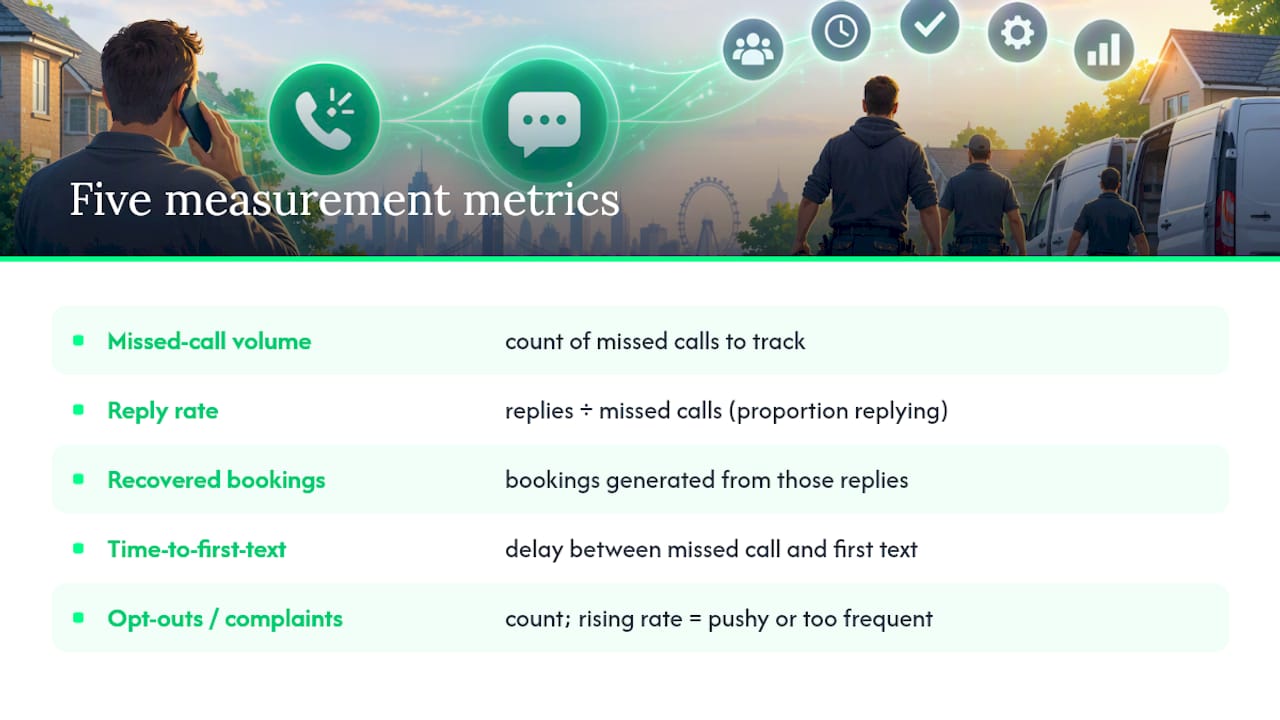
Five numbers tell you almost everything: missed-call volume, reply rate (replies divided by missed calls), bookings generated from those replies, time-to-first-text, and the count of opt-outs or complaints. Watch that last one closely, a rising opt-out rate usually means the message is too pushy or arriving too often.
Log each interaction properly in the CRM: the contact record, a timestamp for both the missed call and the text, the full conversation thread, and where the lead moved in your pipeline afterwards. Without that, you’re guessing at what worked.
The simplest proof is a one-week experiment: run a baseline week with no automated text-back, then a live week with it switched on, and compare recovered bookings and conversion rate side by side. Most businesses see the difference within days.
How SmartFlowCRM handles this end to end
Smartflowcrm runs the whole flow through one system rather than stitching several tools together. The built-in phone system detects the missed call and fires the trigger, SMS marketing sends the text with your chosen sender ID, and replies land in a unified conversations inbox so nothing gets missed twice.
Every reply automatically creates or updates a lead record, tags the contact, and can trigger a follow-up task without anyone touching a spreadsheet. Setup follows the same pattern covered in the checklist above: connect the phone number, build the automation, attach the SMS template, and confirm the CRM record updates on the first test call.
The checklist that actually matters
Strip away the noise and five things decide whether missed call text back works: speed, a credible sender ID, one clear call to action per message, proper CRM logging, and disciplined opt-out handling. Get those right and everything else is polish.
Most failures I’ve seen trace back to the same three mistakes: a message that reads like it was written by a robot, a sender ID that gets blocked or flagged as spam, and follow-up cadences that hound people until they opt out in frustration. None of these are hard to avoid, they just get skipped because they feel like small details.
Test with real calls, not dashboard simulations, and keep an eye on delivery times as your volume grows, because a setup that hits 40 seconds at ten calls a day can slip past a minute at fifty.
— Chris
Get missed call text back running this week
An all-in-one system brings the phone trigger, the SMS, and the CRM record into one place, avoiding the need for multiple subscriptions that don’t integrate or require developer setup. The Starter plan starts implementation at £130 a month, with unlimited contacts and users included rather than charged per seat, and every plan comes with a free trial and no long contract.
If you’d rather have someone build the automation for you, the Done For You plan at £260 a month covers setup end to end. Either way, start with the phone system during your trial, run the same landline-to-mobile test described earlier, and check the reply lands inside a minute before you roll it out across every line in the business. And if overflow calls need more than a text, pairing this with an AI voice agent from Wattle covers the calls a text alone can’t close.
Sources
- ICO guidance on live direct marketing calls
- Missed call text back for service businesses | AnovaGrowth
FAQ
How do you text back when you missed a call?
Send a short, personal SMS within 30 to 60 seconds that acknowledges the missed call and gives one clear next step, such as a booking link or a request to call back. Include a working opt-out like Reply STOP on every message.
What is the missed call text back feature?
It’s an automation that fires an SMS the instant a call goes unanswered, rings out, or hits voicemail, so the caller gets a reply before they try another business. It typically runs through a phone system trigger connected to an SMS provider and a CRM record.
How do I text “Sorry I missed your call”?
Keep it brief and human: name yourself, apologise for missing them, and ask what they need help with. For example, “Hi, it’s Sam from [Business], sorry we missed your call, what can we help with today?”
Should you text after a missed call?
Yes, for most trade services and appointment-based businesses, since it can recover 20 to 40 percent of missed callers when the reply lands within a minute. Skip automated marketing content unless you already have separate consent, and always include an opt-out.
Recommended
Ready to See What SmartFlow Can Do?
Try SmartFlow free and see how it helps small businesses like yours save time and win more customers.
Start Free Trial