Cut Winback CAC to 25–45%: RFM Winback Campaigns for UK Marketers
SmartFlow Team
AI-powered business operating system
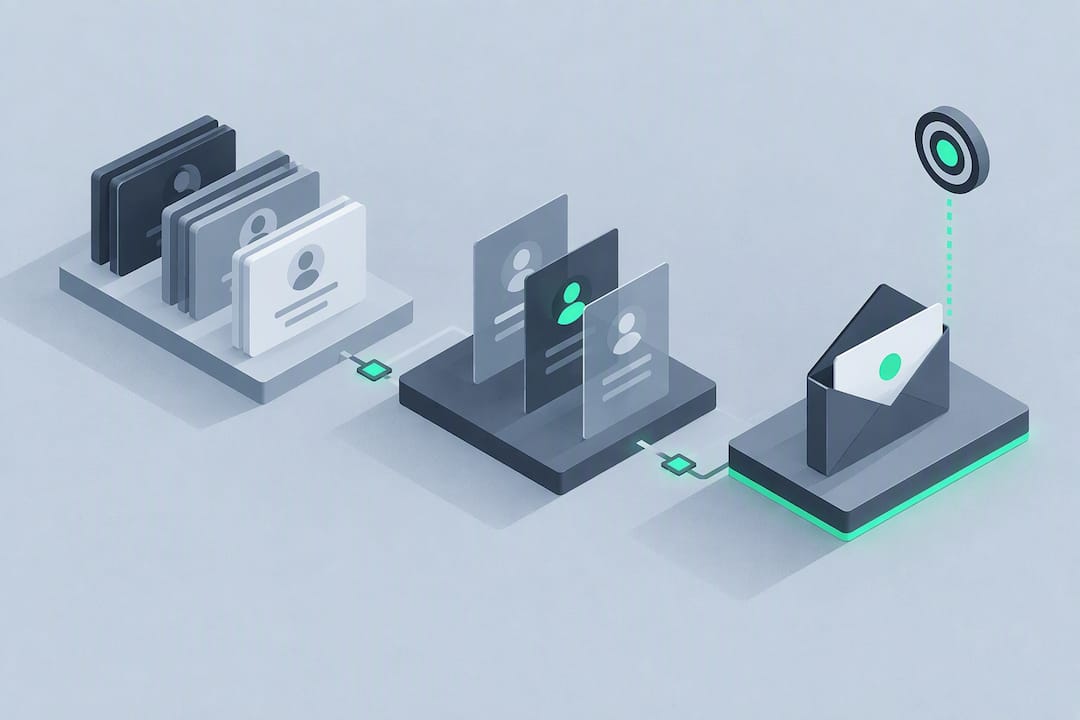
A winback campaign is a targeted sequence of emails, texts, or ads sent to customers who used to buy or engage and have gone quiet. The right approach: rank lapsed customers by value and purchase cycle, then run a short automated sequence, escalating to an incentive only if the first message gets ignored. Most businesses skip the ranking step and lose money mailing everyone the same discount.
TL;DR:
- Successful winback campaigns should rank customers by value and purchase cycle to target high-margin segments with behavior-based triggers.
- The most effective sequences follow a recognize, remind, reward structure, escalating incentives only if earlier messages are ignored.
- Campaigns work best when focused on specific conditions like repeat purchases, renewals, or login re-engagement, rather than multiple goals simultaneously.
- Measuring reactivation rates and winback CAC against a control holdout group is crucial to evaluate true campaign performance.
- Keeping contact consent validated, using cycle-aware triggers, and setting clear sunset rules are essential to maintain deliverability and compliance.
Table of Contents
- What Counts as a Winback Campaign (and What Doesn’t)
- The Real Economics of Winning Customers Back
- Who to Target First: Segmentation, Triggers, and Pre-Send Checks
- The Winback Sequence: Recognize, Remind, Reward
- Which Channels to Use, and When to Add More
- Three Copy-Ready Winback Flows You Can Adapt
- Measuring Whether Your Winback Program Actually Works
- Sunset Rules and UK Compliance You Cannot Skip
- Mapping Winback Decisions to SmartFlowCRM Features
- A Quick Pre-Send Checklist and the Three Mistakes That Sink Most Programs
- Build and Automate Winback Sequences Without Stitching Five Tools Together
- Sources
- FAQ
What Counts as a Winback Campaign (and What Doesn’t)
A winback campaign targets people who already converted and then stopped. Re-engagement is broader. It covers anyone who has drifted from any kind of activity, including people who never bought. Churn prevention is different still. It intervenes before someone leaves, often triggered by a cancellation request or a usage drop, while a winback campaign starts after the relationship has already gone cold.
The distinction matters because the messaging, timing, and offer strategy differ for each. Confusing them is the fastest way to build a sequence that annoys everyone it touches.
Before writing a single subject line, pick the one winning condition that defines success for this specific campaign:
- Repeat purchase: the customer buys again within a set window.
- Renewal: a subscriber restarts or extends their plan.
- Session or login: an app or software user returns and takes a meaningful action.
Pick one. A campaign trying to drive a purchase and a login at the same time usually drives neither.
The Real Economics of Winning Customers Back
Reactivating a former customer costs less than acquiring a new one because you already have their contact details, purchase history, and a working relationship on file. Practitioner benchmarks put winback CAC at roughly 25 to 45% of new-customer acquisition cost, which is the single strongest argument for building this into your calendar every quarter rather than running it as a one-off.
Winback CAC benchmark: Recovering a lapsed customer typically costs 25 to 45% of what it costs to acquire a brand-new one, making winback one of the higher-margin plays in most retention marketing budgets.
Winback investment pays off fastest for businesses with a natural repeat-purchase cadence: subscription boxes, consumables, SaaS renewals, service contracts with renewal dates. If your average customer buys once and disappears for good, winback has less room to work with.
The risks are real too. Mail an unengaged list too often and you damage your sender reputation, hurting deliverability for every campaign you send afterward, not just this one. Lead every sequence with a deep discount and you also train your best customers to wait for a coupon before they buy again, quietly eroding the margin the whole program was supposed to protect.
Who to Target First: Segmentation, Triggers, and Pre-Send Checks
RFM segmentation, short for Recency, Frequency, and Monetary value, ranks lapsed customers by how recently they bought, how often they used to buy, and how much they spent. Start with customers who score high on frequency and monetary value but have gone recently quiet. That group has both the highest reactivation rate and the best margin once they come back.
Before you build a single sequence, work through these steps in order:
- Segment by RFM tier. Separate high-value recent lapses from long-dormant, low-spend contacts. They need different offers and different urgency.
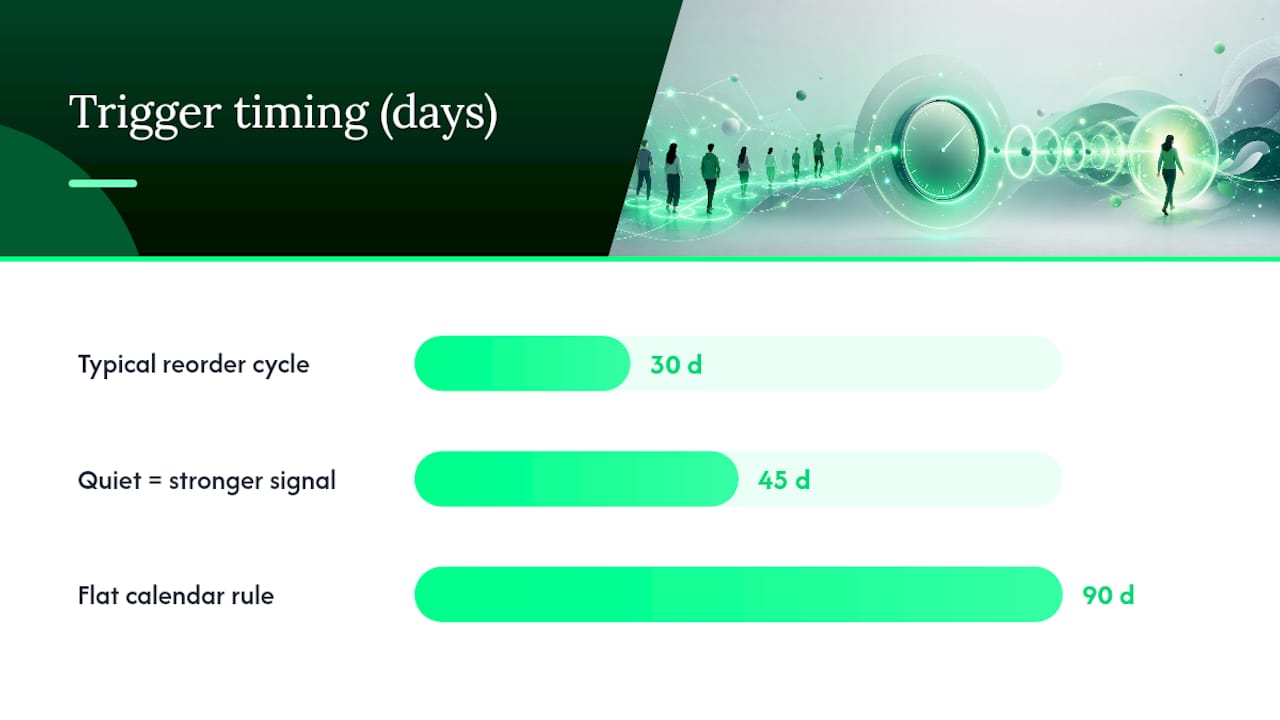
- Set cycle-aware triggers, not calendar rules. A customer who reorders every 30 days going quiet at day 45 is a stronger signal than a flat “90 days since last visit” rule applied to everyone. Defining inactivity relative to each customer’s own reorder cycle catches the right people at the right moment instead of firing too early or too late.
- Validate consent before you send anything. Confirm the contact opted in to marketing communications and that the email or phone number is still deliverable.
- Carve out a holdout group. Hold back 10 to 15% of each segment and send them nothing, so you can measure what the campaign actually caused versus what would have happened anyway.
The Winback Sequence: Recognize, Remind, Reward
Every effective winback campaign follows the same three-phase logic, even when the copy and channel vary by industry. Practitioner guidance frames this as reminder, then incentive, then a final goodbye, and that structure holds up because it escalates cost and pressure only when the cheaper message fails.
Phase 1: Recognize. This message simply acknowledges the customer exists and references something specific: their last purchase, a feature they used, a milestone. No discount yet. A subscription app might send “Your fitness plan is still waiting for you” three days after a lapsed login. A retailer might send “Still thinking about the jacket you saved?” one week after an abandoned cart converts into full inactivity.
Phase 2: Remind. If phase one gets ignored, phase two adds a reason to act now: new inventory, a feature update, a limited restock. Timing here should track the product’s natural cycle. A coffee subscription customer who orders every four weeks should get this message around week five or six, not on a fixed 90 day clock that ignores their actual behavior.
Phase 3: Reward. This is where the incentive appears, and it doesn’t have to be a blanket discount. Options include:
- A percentage or dollar discount, used sparingly and framed as a one-time welcome-back offer.
- A free gift or bonus item tied to their next order.
- Loyalty points or status upgrade for accounts with a points program.
- A downgrade offer or pause option for subscription customers, converting a cancellation into a lower-commitment relationship instead of losing them outright.
Pro Tip: Build a two-step incentive ladder instead of one flat discount. Offer something small and non-monetary in phase two (early access, a bonus item) and reserve the percentage-off code for phase three. Progressive incentives preserve margin and avoid training your whole list to wait for a discount before they buy again.
Which Channels to Use, and When to Add More
Email carries almost every winback sequence because it’s cheap, permission-based by default, and doesn’t strain deliverability the way a poorly targeted text does. Protect that channel by keeping your sending list clean and pausing contacts who show zero engagement across several attempts.
Add other channels only for the segments that justify the extra cost and risk:
- SMS and WhatsApp: reserve these for high-value segments who have given explicit consent for that channel specifically. A text that a customer never agreed to receive is both a poor experience and a compliance risk.
- Paid social and retargeting: useful for top-tier lapsed cohorts where you want a presence beyond the inbox, particularly if their email open rate has already dropped to zero.
- Direct mail: worth the cost for premium AOV segments, where a physical piece stands out precisely because almost nobody else sends one anymore.
Set clear stop rules across every channel: no customer should get an email and a text on the same day for the same offer, and every channel should check the suppression list before it fires. Fatigue from a badly coordinated multichannel push undoes the goodwill a well-timed single message would have built.
Three Copy-Ready Winback Flows You Can Adapt
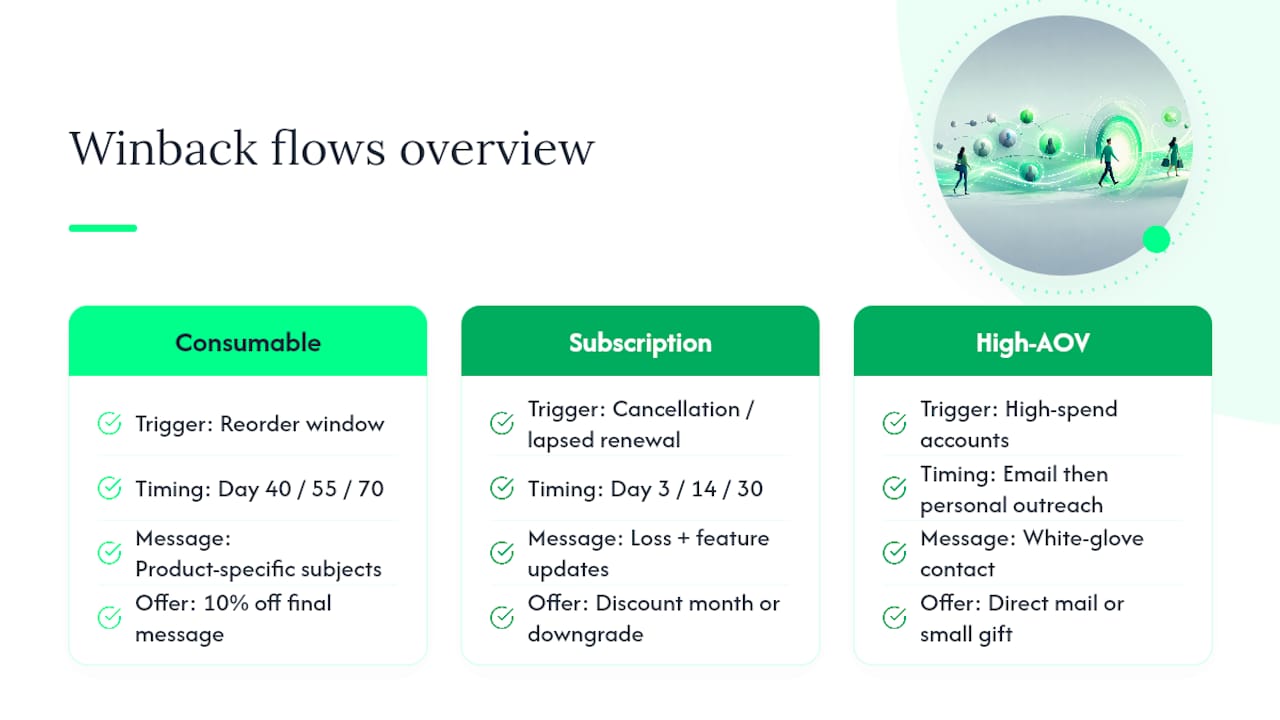
1. Consumable or replenishment flow. Trigger this off the product’s typical reorder window, not a flat day count. A skincare brand with a 45 day average repurchase cycle might send: day 40, “Running low on [product]?”; day 55, “Your favorite is back in stock, plus what’s new”; day 70, “10% off your next order, just this once.” Product-specific subject lines outperform generic “we miss you” copy at every stage of this flow.
2. Subscription restart flow. Trigger on cancellation date or lapsed renewal. Message one arrives at day 3, confirming what they’ll lose access to. Message two at day 14 highlights a new feature or content update since they left. Message three at day 30 offers a discounted restart month or a downgrade to a cheaper tier, framed as a low-pressure way back in rather than a full-price ask.
3. High-AOV or B2B flow. For customers whose average order size justifies white-glove treatment, skip the automated-only approach after message one. Follow an initial email with a personal outreach call or a handwritten-style note, and consider a small physical gift for accounts above a set spend threshold. A direct mail piece here often outperforms a third email because so few competitors still send one.
Insert your holdout group before any of these three flows go live, and validate consent and contact accuracy at the segment level, not the individual send level, so you catch bad data before it burns a slot in the sequence.
Measuring Whether Your Winback Program Actually Works
Two numbers matter more than any other metric: reactivation rate and winback CAC. Reactivation rate is the percentage of a lapsed segment that completes your winning condition (purchase, renewal, login) within the campaign window. Winback CAC is total campaign spend, including any discount cost, divided by the number of customers who reactivated.
Benchmarks vary sharply by segment. High-value, recently lapsed cohorts can hit 8 to 15% reactivation, while long-dormant segments often land at 3 to 7%. Comparing those two numbers without segmenting first will make a healthy program look mediocre or vice versa.
Track these alongside the headline numbers:
- 90-day post-reactivation LTV: whether reactivated customers stick around or churn again almost immediately.
- Holdout comparison: always measure lift against the 10 to 15% group that received nothing, not against last year’s baseline.
- Retest cadence: rerun the same segment through a fresh sequence no sooner than one full cycle after the last attempt, so you’re not mailing burnout into the list.
The most common measurement mistake is crediting a winback campaign for a purchase that would have happened anyway. A holdout group is the only reliable way to catch that.
Sunset Rules and UK Compliance You Cannot Skip
Set a hard sunset threshold, commonly 90 to 180 days of total non-engagement or three to four unopened attempts, after which a contact moves to a suppressed or dormant list rather than staying in active rotation. Mailing dead contacts indefinitely drags down deliverability for your entire program, not just the winback list.
In the UK, PECR requires specific consent for most marketing email and SMS, with a narrow soft opt-in exception for existing customers who bought a similar product and were given a clear chance to opt out at the time. Unsubscribes must be honored and suppressed promptly, not left to process on the next batch.
Practical steps that keep you compliant and out of the spam folder:
- Validate email and phone data before every send cycle, not just at list import.
- Send based on engagement signals, not just list membership.
- Pause a contact immediately once they reactivate, so they don’t receive a winback offer the week after they’ve already come back.
Mapping Winback Decisions to SmartFlowCRM Features
Every decision in a winback program has a corresponding action to take inside the platform running it. Building the segment, validating consent, orchestrating the sequence, suppressing dead contacts, and reporting on results are five separate jobs that usually live in five different tools, unless the platform was built to hold all of them together.
Here’s how each step maps to a specific function:
- Audience build: create RFM-based segments and dynamic lists with audience segmentation tools that update automatically as customers move between tiers.
- Consent validation: track opt-in status per contact so a segment never includes someone who hasn’t agreed to that channel.
- Automation canvas: build the recognize, remind, reward sequence with branching logic through workflow automation, so the third message only fires if the first two got ignored.
- Channel sends: run the email leg through email marketing and add SMS marketing only for the high-value segments that consented to it.
- Suppression and reporting: pause reactivated contacts automatically and track reactivation rate and cohort performance from one dashboard.
A Quick Pre-Send Checklist and the Three Mistakes That Sink Most Programs
Before any sequence goes live, confirm five things: the segment is ranked by value, the trigger is tied to behavior rather than a flat calendar date, consent is validated, a holdout is carved out, and the offer escalates rather than opens with a discount. Skip any one of those and the program underperforms quietly, without ever telling you why.
The three mistakes I see most often: mailing everyone the same message regardless of value, leading with a discount because it feels like the safe move, and treating consent and deliverability as an afterthought instead of the foundation the whole program sits on.
— Chris
Build and Automate Winback Sequences Without Stitching Five Tools Together
Most winback programs stall because the segmentation lives in one tool, the email sends from another, the SMS consent tracking sits in a spreadsheet, and nobody owns the suppression list. The platform keeps every piece of that under one dashboard, so the recognize, remind, reward sequence you just read about takes one build instead of five separate logins.
Segment lapsed customers by value inside audience segmentation, build the escalating sequence in workflow automation, and send the email and SMS legs from email marketing without switching platforms mid-campaign. The Starter plan starts the whole setup at £130 per month, with a free trial and no long contract if you want to test one winback flow before committing further. Check current pricing and start a free trial on the pricing page.
Sources
- Win-Back Campaigns: 7 Strategies to Re-Engage Lapsed Customers (Shopify)
- Master Win-Back Campaigns: The Ultimate CleverTap Strategy
- How to Build a DTC Win-Back Engine That Scales Past $55M
FAQ
What Are Winback Campaigns?
A winback campaign is a sequence of emails, texts, or ads aimed at customers who used to buy or engage and have since gone inactive. It typically follows a recognize, remind, reward structure and works best when targeted using RFM segmentation rather than a flat calendar rule.
Can You Provide Some Examples of Winback Campaigns?
A consumable brand might send a restock reminder timed to a customer’s usual reorder window, followed by a small discount if that message is ignored. A subscription service might send a “here’s what you’ve missed” email at cancellation, then a discounted restart offer two to four weeks later. Both follow the same escalating logic covered in the flow examples above.
What Are the Top 10 Best Marketing Campaigns?
There’s no single agreed-on top ten list for marketing campaigns generally. Within retention marketing specifically, the strongest winback campaigns share three traits: cycle-aware timing, value-based segmentation, and an incentive that escalates instead of leading with a discount.
What Is a Winback Offer?
A winback offer is the incentive used in the final stage of a reactivation sequence, ranging from a percentage discount to a free gift, loyalty bonus, or subscription downgrade option. Progressive incentive ladders that start small and escalate tend to protect margin better than a flat discount offered right away.
How Do I Know if My Winback Campaign Is Working?
Compare reactivation rate and winback CAC against a holdout group that received no messages, not against last year’s numbers. High-value recently lapsed segments often reactivate at 8 to 15%, while dormant segments typically run lower, so always benchmark within the same cohort tier.
Recommended
Ready to See What SmartFlow Can Do?
Try SmartFlow free and see how it helps small businesses like yours save time and win more customers.
Start Free Trial